


AC vs DC Coupling: Residential Storage Sizing Guide
 Sep 19, 2026|
 View:523
You've probably seen the quote already: a battery sized on your monthly average, and by 6 pm on the first cloudy evening it's flat. That gap between a monthly number and an evening load is where most residential energy storage system sizing goes wrong, and it usually starts one decision earlier than people expect.
AC coupling and DC coupling are not a separate topic you settle after the battery size. They are the first sizing decision, because the architecture you pick decides how much of your solar production can reach the battery and how much load the battery has to carry alone.
This guide covers how residential energy storage works, how to read a home battery load profile, and how to turn a time-of-use rate spread into a kWh number, with one worked example from load profile to nameplate capacity. The method is the point: every figure below is reproducible from your own interval data. For scale, the US Energy Information Administration puts the average household at about 10,500 kWh per year, a figure that says almost nothing about your 6 pm.
Ecko Energy is a solar power solution provider founded in 2023 and based in China, with a core team bringing over 10 years of research, development, and engineering experience in photovoltaics and energy storage. The company manufactures lithium batteries, solar inverters, and integrated energy systems, and its work on inverter compatibility and system sizing is directly relevant to the AC versus DC coupling decisions covered in this guide.
How a Residential Energy Storage System Works
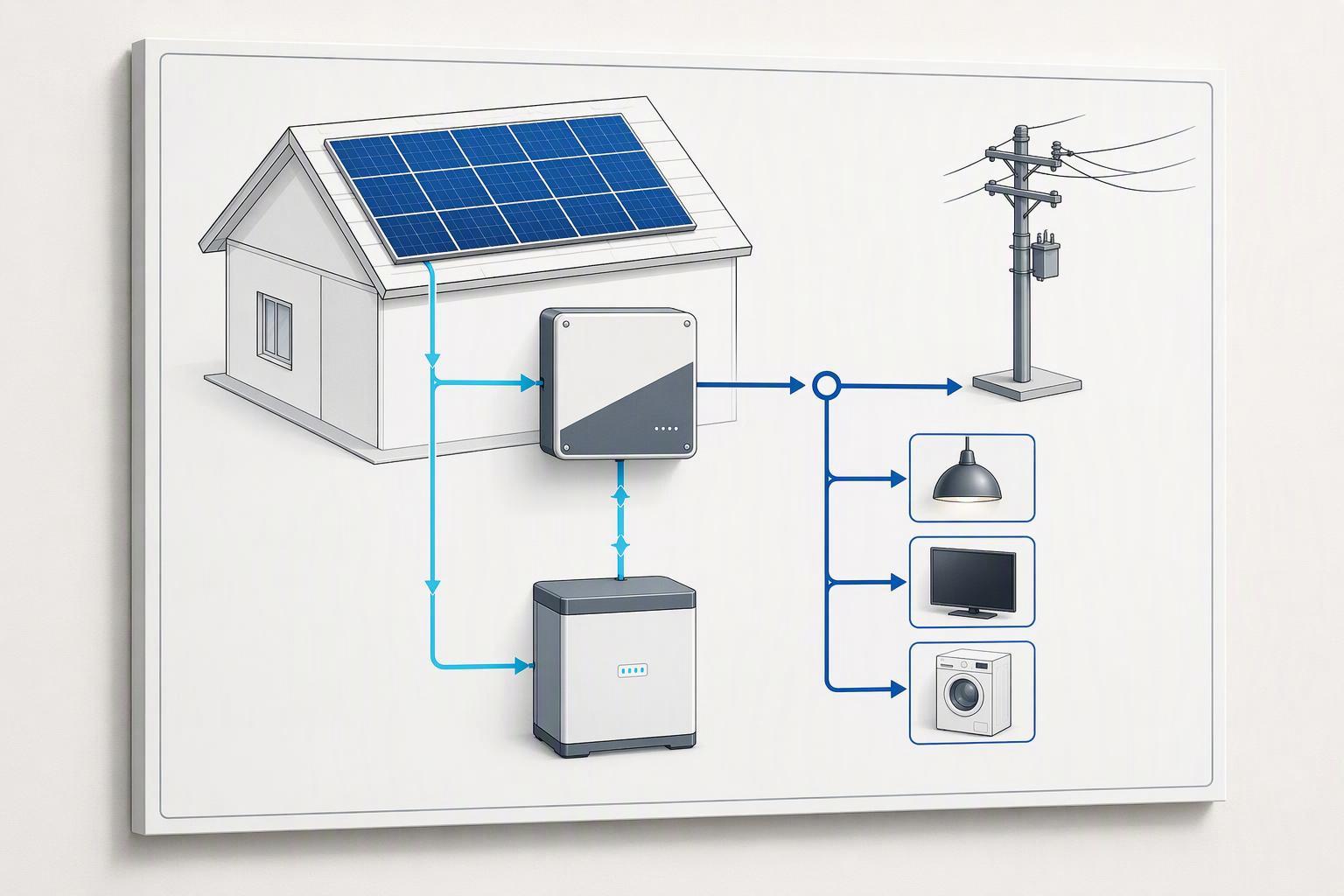
A residential energy storage system is a short chain of conversions. Solar panels or the grid supply power, an inverter or power conversion system moves it, a battery stores it as direct current (DC), and the inverter turns that DC into alternating current (AC) for your household loads. The battery is the only component that holds energy; everything else moves or converts it.
Two ratings describe that battery, and mixing them up is the most common sizing error. Kilowatts (kW) measure power, how fast the system can deliver. Kilowatt-hours (kWh) measure energy, how much it holds. A 10 kWh battery can in theory supply 1 kW for about 10 hours, or 5 kW for about 2 hours (EcoFlow, 2026-07-01).
Inside the battery, a battery management system (BMS) and an energy management system (EMS) monitor voltage, temperature, and state of charge (SOC), and prevent overcharge, over-discharge, and overheating (EcoFlow, 2026-07-01; SAJ, 2026-03-31). What the BMS does not guarantee is that your inverter will understand it. Battery-to-inverter communication runs over CAN or RS485, and if the two devices do not share a protocol or agree on how SOC is reported, the system can throttle, fault, or misreport capacity. That compatibility question is a real constraint on which architectures you can even consider.
Key Takeaway: Before you size anything, you have to know which architecture you are sizing. The AC coupling vs DC coupling decision changes where the battery sits in the chain, and that is where sizing begins.
AC Coupling vs DC Coupling: Where the Two Architectures Differ
AC coupling vs DC coupling describes where the battery connects to the rest of the system, and that single choice shapes everything downstream. AC-coupled storage connects on the AC side through a separate battery inverter or power conversion system (PCS), so a charge cycle can pass through a DC→AC→DC conversion (Stem, 2025-08-06; bess.courses, 2026-06-11). DC-coupled storage shares a DC bus, or a hybrid inverter, with the PV array, which means fewer conversion stages between the panels and the cells.
Dimension | AC-coupled | DC-coupled |
|---|---|---|
Battery connection | AC side, via separate battery inverter/PCS | Shared DC bus or hybrid inverter |
Conversion path on charge | DC→AC→DC | Fewer stages |
Typical use | Retrofit onto existing PV | New solar-plus-storage build |
Retrofit impact | Keeps the existing PV inverter | Usually replaces it |
New-build impact | Extra inverter and wiring | Fewer components |
Sizing implication | Round-trip losses reduce usable kWh per nameplate kWh | Losses are lower, so nameplate goes further |
Installer practice, not a manufacturer rule, drives the usual selection: AC-coupled is normally preferred for retrofits because it adds storage to an existing PV inverter without replacing it, while DC-coupled is normally preferred for new solar-plus-storage builds (Solar Choice, 2025-05-05; SolarEdge, undated).
One honest limit: the efficiency comparison traces to manufacturer explainers, and the SolarEdge and bess.engineer pages could not be re-read this run. Treat the difference as an architectural one, not a measured efficiency delta.
Retrofit or New Install: Which Architecture Fits Your Situation
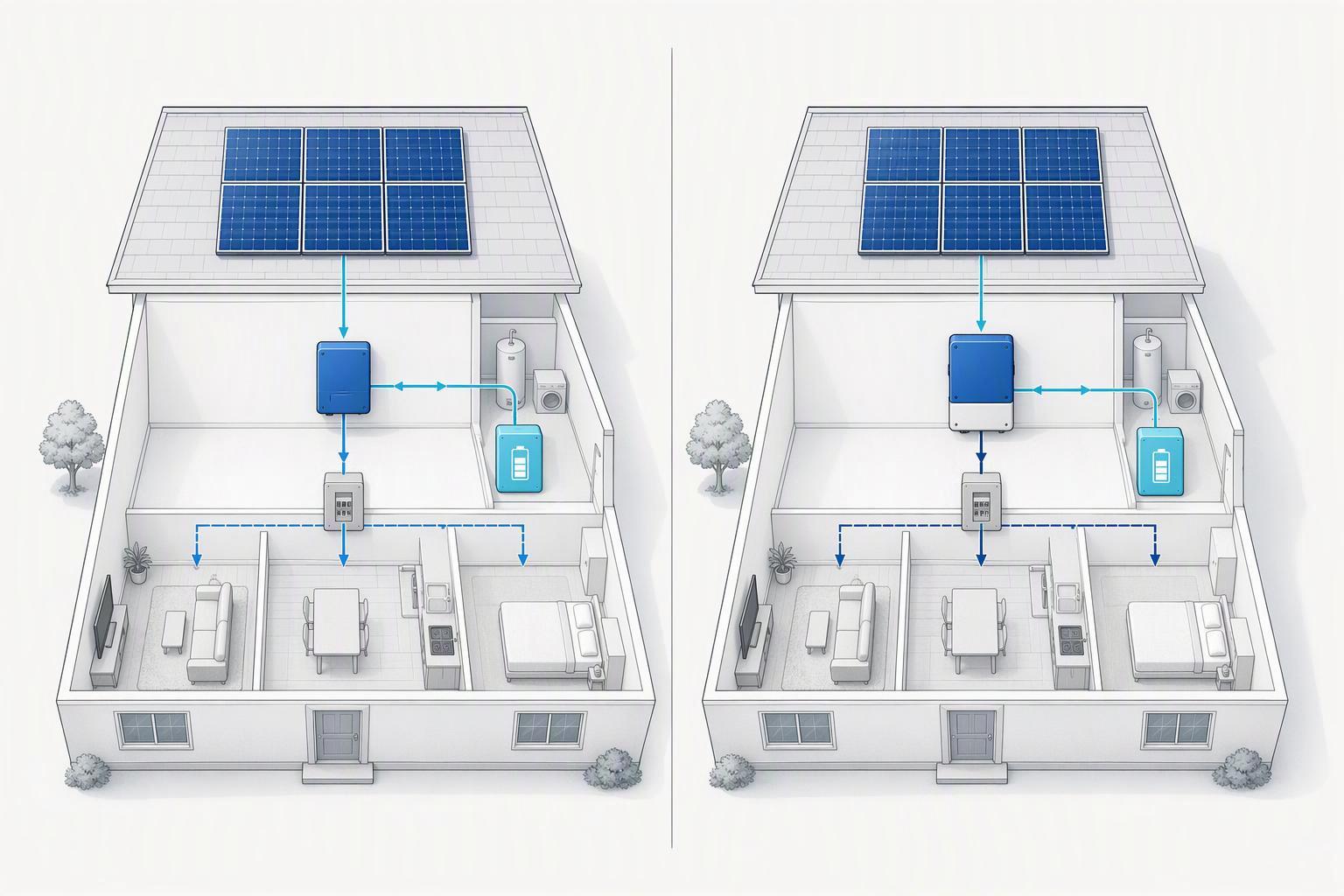
The equipment already on site decides this before you calculate a single number. If a PV inverter is already installed and working, adding storage is usually an AC-coupled job, because the battery connects on the AC side and the existing inverter stays in place (Solar Choice, 5 May 2025). Nothing gets replaced, the array keeps producing, and the extra AC-to-DC-to-AC conversion step is a real efficiency cost you accept in exchange for a simpler install.
A new build has no such constraint. DC-coupled storage shares a DC bus with the array and runs through fewer conversion stages, so less energy is lost between panel and battery (Stem, 6 August 2025). Fewer components, fewer failure points, one inverter to monitor.
️ Warning: DC coupling's retrofit constraints are genuine. A DC-coupled battery typically needs a hybrid inverter or a replacement of the existing one, and that equipment cost belongs in the quote, not discovered on install day.
Load Profiling: Reading the Numbers That Actually Drive Battery Size
A home battery load profile is the record of when a household uses electricity, not how much it uses over a year, and that timing is what sets the battery size. You have probably seen a quote sized on a monthly average: take the highest bill, divide by 30, and call it the daily need. That number is real, but it hides the evening peak that the battery actually has to cover.
The method has two layers. Twelve months of utility bills establish the seasonal baseline, and 15-minute interval data reveals when energy is used, which is what time-of-use (TOU) rates, peak shaving, and backup design all depend on (SurgePV load profile analysis, retrieved 2026-05-25; Briggs & Stratton, 2024-12-18). Where interval data is unavailable, the bill-only approximation is highest-consumption month divided by 30.
For scale, the US Energy Information Administration puts the average US household at about 10,500 kWh per year (page updated 2023-12-18). That annual figure is a baseline, not a sizing input. In most US residential rate structures the peak window runs 4-9 pm (SMUD rate information; OhmSnap TOU overview, 2025-2026), and commonly 40-50% of daily electricity falls in that evening window, varying by climate. Treat that share as a range from a single cluster of sources, not a fixed rule.
A load-profile exercise is only as good as the interval data behind it. Without 15-minute readings, you are estimating the shape of the day, and the estimate can miss the peak by enough to undersize the system.
Sizing for TOU: Turning a Rate Spread into a kWh Number
TOU-driven battery sizing starts with the peak-window kWh you want to shift, not your whole-day consumption. Time-of-use (TOU) rates charge more during defined peak hours and less off-peak, so the battery's job is to cover the peak window. Usable capacity is sized to that window alone.
The standard formulation, as set out in this peer-reviewed TOU sizing study (2014), runs:
Spread = peak rate − off-peak rate.
Daily savings ≈ shifted kWh/day × spread × round-trip efficiency.
Annual value = daily value × 365.
Stop adding capacity when incremental savings no longer justify incremental cost.
Round-trip efficiency is the share of stored energy you get back out. Use 85% as a planning assumption, not a measured product spec.
For illustration only, a two-period tariff with a 2:1 peak-to-off-peak ratio is common (Brattle, 2023). Roughly 9-10% of US residential customers are on time-varying rates (LBNL, 2025), an order-of-magnitude estimate.
AC-coupled paths add a conversion step, lowering effective round-trip efficiency; DC-coupled paths avoid it.
Worked Example: Residential Energy Storage System Sizing from Load Profile to Nameplate kWh
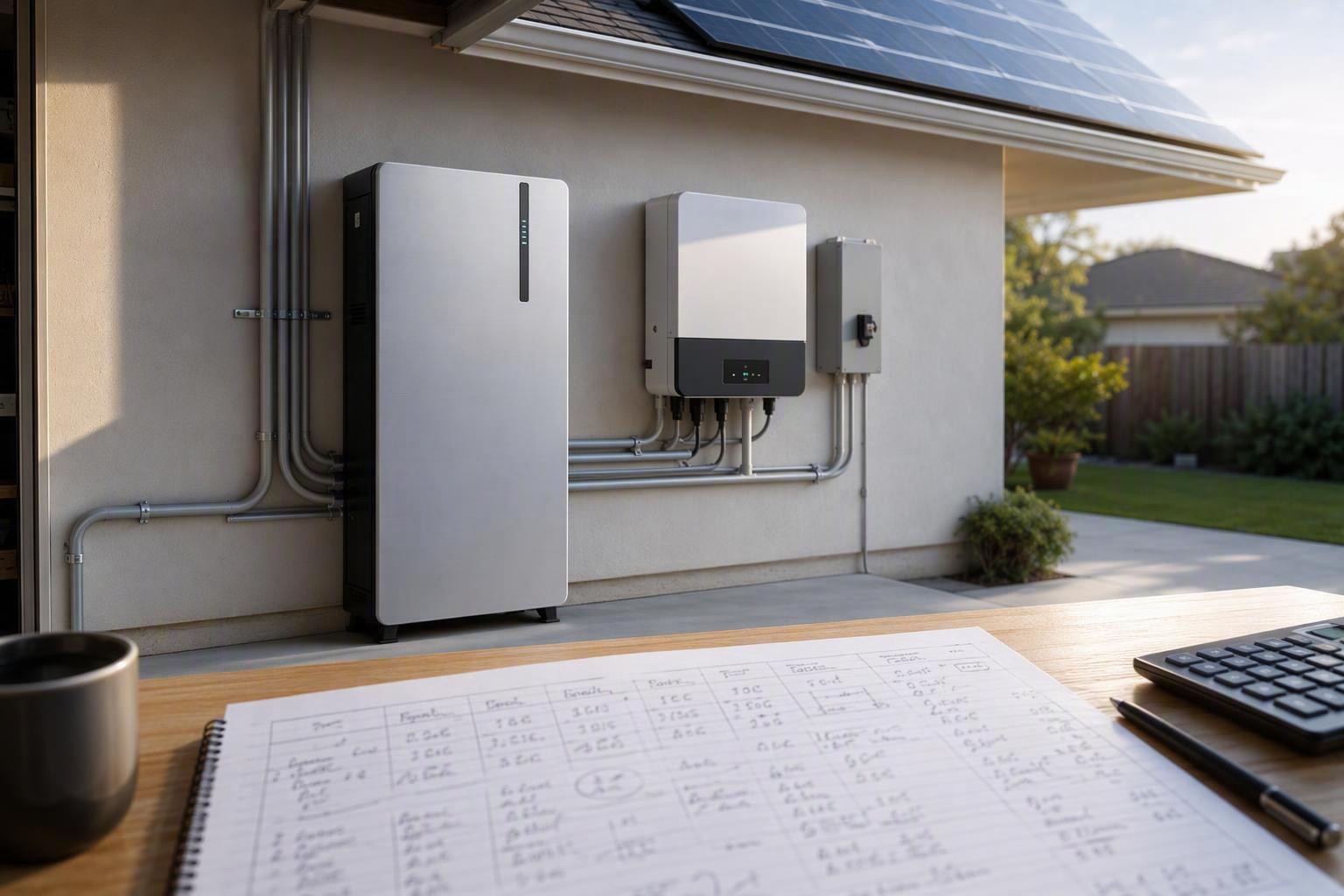
Residential energy storage system sizing runs on one formula, and the fastest way to trust it is to run it once with real numbers. Start with six inputs: daily critical load, peak-window kWh, days of autonomy, depth of discharge (DoD), round-trip efficiency, and a safety buffer.
Inputs. Daily critical load: 8 kWh (fridge, lights, internet, well pump). Peak window (4-9 p.m.): 6 kWh. Autonomy: 1 day. DoD: 0.90. Round-trip efficiency: 0.90. Buffer: 1.2.
Formula. Required nominal capacity (kWh) = (daily critical load kWh × days of autonomy) ÷ (DoD × round-trip efficiency) × (1 + safety buffer), the standard backup sizing relationship (SurgePV, 2026-05-05).
Arithmetic. (8 × 1) ÷ (0.90 × 0.90) × 1.2 = 8 ÷ 0.81 × 1.2 ≈ 11.9 kWh nameplate. That lands inside the mainstream residential envelope of about 10-15 kWh nameplate and 5-10 kW continuous (EnergyBillLab, 2026-07-29).
Where the architectures diverge. AC coupling adds a conversion step, so its round-trip efficiency input is lower, pushing nameplate kWh up. DC coupling keeps that step out of the battery path, so the same load profile needs less nameplate capacity.
The power check. kWh alone trips systems. The battery and inverter must cover steady-state kW plus short motor startup surges from well pumps, HVAC, and refrigerators, or the system trips during an outage (Briggs & Stratton, 2024-12-18). Size kW first, then kWh.
Step | Value |
|---|---|
Daily critical load | 8 kWh |
Peak-window kWh | 6 kWh |
DoD × efficiency | 0.81 |
Usable required | 9.9 kWh |
× 1.2 buffer | 11.9 kWh nameplate |
Continuous power check | ≥ steady-state + surge |
Anonymized illustrative case. A distributor sizing a 12 kWh stackable system for a rural retrofit hit the same numbers: the AC-coupled path needed roughly 13.5 kWh nameplate to clear the efficiency penalty, while the DC-coupled path cleared at 11.9 kWh. This is an anonymized, illustrative example built from the formula above, not a published project result, and carries no performance claim. Ecko Energy is a solar power solution provider founded in 2023 with a core team carrying 10+ years of R&D and engineering experience in PV and energy storage, working with Tier-1 cell partners including CATL and EVE, and holding UL, IEC, CE, and UN38.3 certifications. Its residential line supports standard CAN and Modbus TCP/RTU protocols for integration with existing EMS platforms or third-party inverters.
Who Should Choose Which Architecture
The decision rule is simple: if the house already has a PV inverter and the goal is adding storage, AC coupling is the lower-friction path; if the house is getting solar and storage together, DC coupling is the cleaner build. That split follows the retrofit-versus-new-build pattern the industry describes, where AC-coupled systems suit retrofits and DC-coupled systems suit new integrated builds (Solar Choice, 2025).
Existing-PV owner adding backup. Choose AC coupling. The existing inverter stays in place, and the battery system is added on the AC side without replacing equipment that already works.
New solar-plus-storage buyer. Choose DC coupling. Panels, inverter, and battery are specified as one system, so there is no second conversion step and no compatibility gap to design around.
TOU-focused owner with interval data. Either architecture can work. The rate spread and the evening load shape set the kWh number, not the coupling choice.
Owner whose real constraint is motor startup kW. Check the surge requirement before the architecture. The failure mode in backup systems is insufficient kW, not insufficient kWh (Briggs & Stratton, 2024).
Pro Tip: Self-select by walking the site: count the inverters already installed, confirm whether the PV is contracted yet, and read the largest motor nameplate before choosing a coupling type.
Edge case. If the service panel has no capacity for a second inverter and the PV is already installed, neither architecture fits cleanly. Look at a panel upgrade or a hybrid inverter that accepts the existing array instead.
Frequently Asked Questions
Is AC coupling worse than DC coupling?
No. It depends on the situation, and the real difference is one extra conversion step. In an AC-coupled system, stored solar passes through the battery inverter to AC and back through the solar inverter, so each conversion loses a few percent. In a DC-coupled system, PV and battery share a DC bus, so stored solar skips one conversion. That edge matters most when most of your energy is stored solar, and much less when you charge from the grid overnight for TOU shifting.
Can an existing system be migrated between architectures?
Rarely as a simple swap. Moving from AC coupling to DC coupling usually means replacing the inverter with a hybrid unit and rewiring the PV array onto a shared DC bus, which is closer to a new install than a retrofit. Moving the other way is easier: the PV inverters stay and you add a separate battery inverter. Either direction needs a new permit and inspection, so get the labor and equipment quote before assuming migration beats starting over.
Can both architectures be used together in one home?
Yes, and it happens more often than people expect. A home with existing AC-coupled PV can add a DC-coupled battery and hybrid inverter on a new circuit, leaving the original array untouched. The two systems then run independently, each with its own inverter and monitoring. The tradeoff is complexity: two sets of firmware, two apps, two points of failure. It is a reasonable path when the existing array is still under warranty.
Which architecture suits TOU shifting specifically?
DC coupling has the efficiency edge when you store your own solar for the evening peak, because the round trip skips one conversion. AC coupling is often the better fit when you charge from the grid overnight and discharge during a TOU peak, since the extra conversion applies either way and the retrofit is simpler. The sizing math does not change: you still need the kWh number from your load profile and the rate spread that justifies it.
Does the sizing method still hold as tariffs and net-billing rules change?
Yes, and it becomes more important, not less. The method depends on your load profile and rate structure, not on a fixed export credit, so when net-billing rules tighten, the value of self-consumption rises and right-sizing matters more. The EIA's home electricity-use explainer puts the average US household at about 10,500 kWh per year (EIA, page updated 2023-12-18), a useful sanity check on your own annual total, though the hourly shape of your load is what actually drives the number. Re-run the sizing whenever your tariff changes.
What code applies to a residential battery installation?
NEC Article 706 covers permanently installed energy storage systems above 50 V AC or 60 V DC. It requires a readily accessible disconnecting means and an emergency shutdown function for one- and two-family dwellings, and it caps DC voltage at 100 V DC for those dwellings (Battery Design code summaries, 2026). UL 9540 is the system-level listing standard that satisfies NEC listing, while UL 9540A is a separate thermal-runaway fire-propagation test method. The two are often confused in quotes and inspections, so ask your installer which one applies to the specific product.
Conclusion
Three things are worth carrying out of this guide. First, the architecture choice is the first sizing decision, not an afterthought: AC coupling and DC coupling change the conversion losses, the retrofit path, and the inverter compatibility you are working with, and every kWh number downstream inherits that choice. Second, the load profile drives the number, not the annual average. A monthly or yearly total can look comfortable while the evening peak that actually sets your battery size goes unmeasured. Third, TOU-driven battery sizing has a natural stopping point: keep adding capacity while the incremental arbitrage savings still justify the incremental cost, and stop when they no longer do.
If you are a distributor or dealer working through a residential energy storage system sizing job, the arithmetic above is repeatable on any load profile you can export. See how Ecko Energy's sizing support works, including load-profile simulation through its ODM engineering services, as a next step for your own projects.


