


Can Solar Power a Frost-Protection Heat Pump Reliably?
 Sep 15, 2026|
 View:534
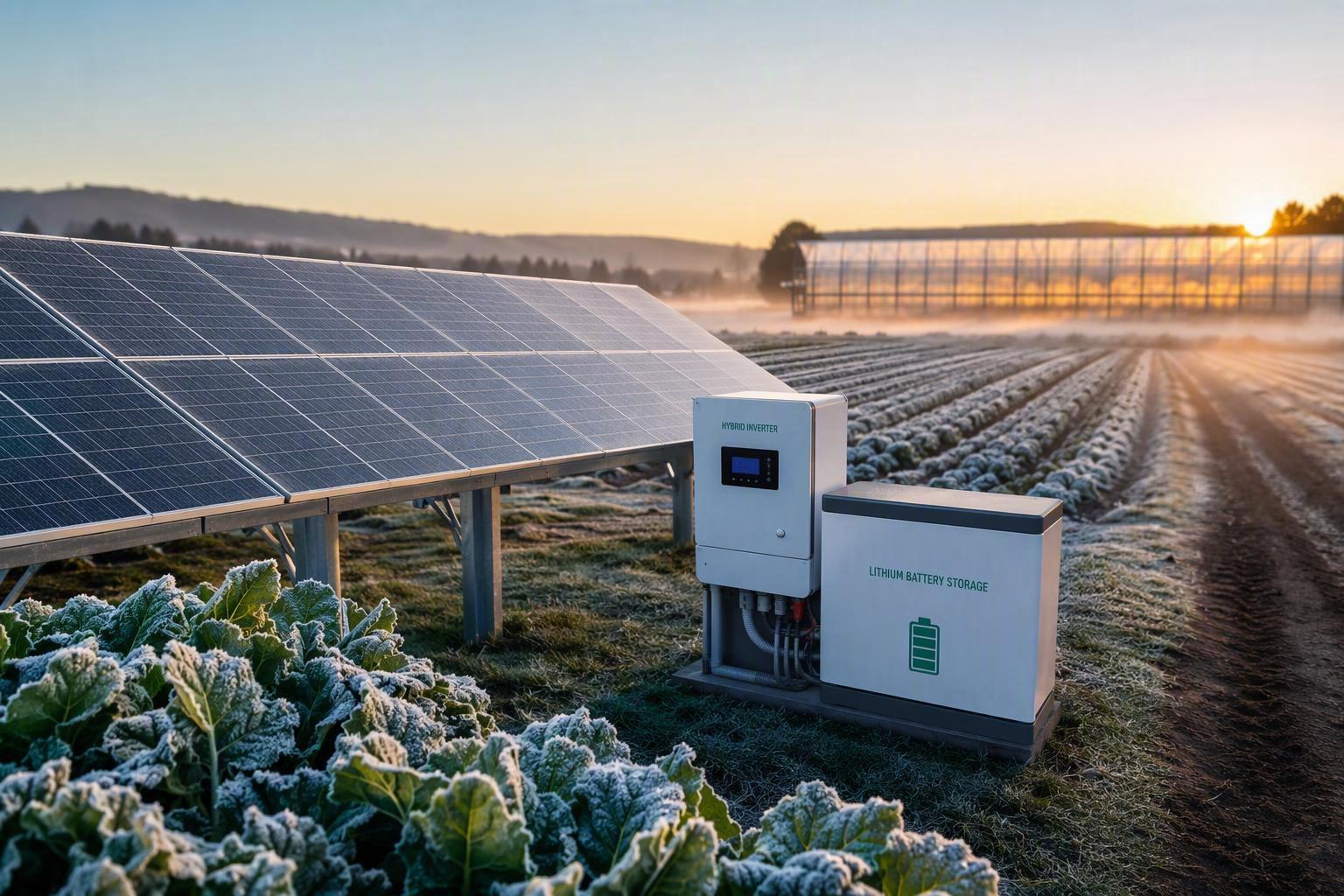
Here is the uncomfortable truth that most solar sales pitches skip: frost happens at night, and solar panels don't generate power at night. If you are sourcing or specifying a solar power system for greenhouse operations or farm clients, this timing mismatch is the first thing you need to understand — and the first thing your system architecture needs to solve.
The short answer to the question above is yes, solar can reliably power a frost-protection heat pump. But only when the system is designed correctly. A solar array alone is not enough. The reliability comes from what you pair with it.
The Core Challenge: Frost Events Don't Follow the Sun
Frost damage occurs most frequently during clear, calm nights when the ground rapidly loses heat through radiation. That is exactly when a photovoltaic array produces zero electricity — a hard limit that applies just as much to a greenhouse solar power system as it does to an open orchard. Research published in the EECA's Forest Lodge Orchard case study confirms what growers already know from experience: frost-fighting equipment, including fans and heat pumps that draw significant power loads, runs during the most solar-unfavorable hours of the day.
Add to this the fact that winter also reduces daytime solar output through shorter hours, lower irradiance angles, and cloud cover. A 2023 analysis of PV-assisted heat pump systems in northern climates found that a system sized purely to rated heat pump input power can achieve a self-supply ratio as low as 16.7% without storage — meaning the solar panels are doing almost none of the actual frost-protection work.
The gap between solar generation timing and frost-protection demand is not a minor footnote. It is the central design problem.
Warning: A solar array without battery storage cannot reliably power a frost-protection heat pump. Sizing panels to the heat pump's rated wattage does not solve the timing problem — it just measures the wrong variable.
Why Battery Storage Is the Missing Link
When you add a properly sized battery to the system, the dynamic changes completely. Daytime solar generation charges the battery bank. The battery discharges overnight to run the heat pump through the frost window. The grid (or a generator) provides a safety net if the frost event lasts longer than the battery's autonomy.
This is the architecture that works in practice: PV array + LiFePO4 battery storage + hybrid inverter + heat pump.
For distributors and installers building out their product catalog, this means frost-protection solar systems are not a single-SKU sale. They require four integrated components, and the battery is the component most often undersized or omitted from a first-pass quote.
Sizing the battery correctly starts with the heat pump's actual runtime demand during a frost event, not its nameplate wattage. A heat pump running at 5 kW through a 4-hour frost window needs approximately 20 kWh of usable battery capacity before adding a 10–25% margin for conversion losses and cold-weather derating. A solar power system for greenhouse heating has to meet the same math — the glass-house structure simply changes the load profile, not the storage requirement. For farms with longer overnight frost exposure or two-night autonomy requirements, the BESS solutions for agricultural applications need to scale accordingly — often into the 40+ kWh usable range.
LiFePO4 (lithium iron phosphate) chemistry is the standard choice for this application. Its thermal stability, cycle life exceeding 3,500 cycles at 80% depth of discharge, and reliable performance at low ambient temperatures make it suited for the outdoor and semi-rural conditions where frost-protection systems operate. Other lithium chemistries perform worse in cold, which is a real liability when the load only runs in freezing conditions.
What a Reliable System Architecture Looks Like
A well-specified solar frost-protection system has three non-negotiable elements beyond the heat pump itself:
1. A correctly sized PV array The array needs to cover the heat pump's average daytime energy consumption plus enough surplus to fully recharge the battery before the next frost window. In practice, this typically means oversizing the array relative to the inverter's rated power — a 1.2× to 1.5× oversize ratio is common for cold-climate agricultural systems. A high-efficiency hybrid inverter with MPPT efficiency at or above 98% maximizes how much of the available winter sunlight actually reaches the battery.
2. A battery bank sized to the frost event, not the panel output The heat pump runtime during a frost event defines the battery requirement. Installers who size battery storage to "match the solar panels" routinely undersize the system for the actual load profile. Work backward from the worst-case frost scenario: how many kWh does the heat pump need, for how many hours, with what frequency?
3. A hybrid inverter with reliable off-grid or backup capability The inverter needs to manage simultaneous solar input, battery charge/discharge, heat pump load, and — for grid-tied systems — seamless switching if grid power fails during a frost event. An off-grid solar power system architecture, or a hybrid setup with grid backup, is the practical choice for most farms because grid reliability varies significantly in rural areas.
Pro Tip: When speccing for a farm client, ask specifically about their frost event profile — not just the heat pump's wattage. The relevant questions are: how many hours per night does active frost protection run, and how many consecutive frost nights should the system handle without grid support?
Practical Sizing: A Worked Example
A small orchard operation with an air-source heat pump drawing 6 kW during active frost protection, with a typical 5-hour frost window and a requirement for 2 nights of grid-independent operation:
Minimum usable battery capacity: 6 kW × 5 h × 2 nights = 60 kWh usable
Nameplate capacity (at 80% DoD): 60 ÷ 0.8 = 75 kWh nameplate
After 15% loss margin: approximately 86 kWh nameplate as the starting specification
A system like Ecko Energy's 8kW hybrid solar system with 10–20kWh battery storage covers smaller orchard loads. For larger operations or multi-night autonomy, C&I-scale BESS solutions in the 100–372 kWh cabinet range are the appropriate specification tier.
These numbers are a starting point, not a quote. Every site needs its own load profile, frost-event history, and irradiance data before final sizing.
Common Misconceptions Worth Addressing
"We can just use grid backup when frost hits." This works until it doesn't. Rural grid outages occur most frequently during winter storms — the same conditions that drive frost risk. A system that depends entirely on grid backup for frost protection is not a frost-protection system; it is a grid-connected heat pump with solar panels attached.
"If the panels are big enough, we don't need batteries." Panel output is zero at night. No panel size changes that. Storage is not optional for reliable overnight frost protection.
"Cold weather hurts heat pump efficiency too much to be worth it." Modern cold-climate air-source heat pumps maintain useful COP values down to -15°C or lower. The heat pump's cold-weather performance needs to be specified correctly, but it is not a reason to avoid the architecture — it is a reason to choose the right heat pump model.
What This Means If You're Building a Product Catalog
For OEM/ODM distributors and private-label installers, the frost-protection use case represents a real system sale, not a panel sale. Whether your customer is running a solar power system for greenhouse production or an open-field orchard, they need a complete architecture — PV, storage, inverter, and load — and the battery specification is the variable that makes or breaks system reliability.
The distributor who can walk a farm client through the frost-event sizing logic, explain why LiFePO4 chemistry outperforms alternatives in cold conditions, and deliver a factory-certified, warranty-backed complete kit has a significant advantage over a competitor selling individual components.
Ready to specify a frost-protection solar system for your next project? Ecko Energy's engineering team works with distributors and installers to size BESS and inverter configurations for specific agricultural load profiles. Get in touch to discuss your project requirements.


