


How to Size a Home Battery for Backup Power
 Sep 23, 2026|
 View:220
Most home battery backup sizing decisions fail for the same reason: the buyer compares a nameplate kilowatt-hour figure to a vague sense of what the house needs, and never checks the two numbers that actually decide the answer. This worksheet replaces that guess with four figures you write down yourself: continuous watts, worst-case combined surge watts, usable kWh against the customer's stated outage duration, and expandability headroom.
The scope is your critical loads, not the whole house. US homes average about 10,500 kWh a year, or roughly 29 kWh a day (US Energy Information Administration), and no residential battery is sized against that total. Outage duration sets the other half of the question: US customers averaged 5.5 hours of outages in 2022, but only about two hours once major events are excluded (EIA).
Every number in the worksheet comes from a spec sheet or from your own nameplate reading. Where a supplier's claim cannot be traced to either, the worksheet records it as unverified rather than counting it.
Ecko Energy is a solar and energy storage manufacturer founded in 2023 and based in China, with a core team holding over 10 years of research, development, and engineering experience in photovoltaics and energy storage. The company produces lithium batteries, solar inverters, and integrated energy systems from its own R&D and warehouse facility, which is the equipment this sizing worksheet is designed to evaluate.
Step 1: List the Critical Loads and Record Continuous Watts
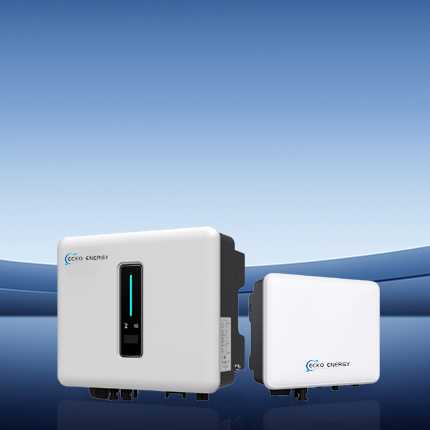
By the end of this step you have one column of numbers: the running watts for every circuit the customer actually wants backed up. That column decides everything downstream, so build it before you look at a single battery datasheet.
Scope first. US homes average about 10,500 kWh a year, or roughly 29 kWh a day, according to the US Energy Information Administration. Sizing a battery to that whole-home average is the most common scope error in home battery backup sizing, and it produces an oversized, overpriced system. A critical-load list is the correct scope.
Walk the property and write down only the circuits on the backup panel: fridge, well pump, furnace blower, sump pump, internet router, a few lighting circuits, medical equipment if relevant. Then record continuous watts for each.
Appliance or circuit | Nameplate running watts | Quantity | Running-watts subtotal |
|---|---|---|---|
Refrigerator | |||
Well pump | |||
Furnace blower | |||
Sump pump | |||
Router and modem | |||
Lighting circuits | |||
Step 1 total |
Verification checkpoint: every row has a source. If a nameplate is missing or illegible, measure the circuit with a clamp meter under normal load and record the reading instead.
A generic appliance wattage table is a starting point only. Nameplate ratings and clamp readings are the authority, because two fridges of the same size can differ by hundreds of watts.
Step 2: Sum Continuous Load and Compare It to the Inverter Rating
Add every watt figure from your Step 1 list. The total is your continuous load, and the inverter's continuous output rating must meet or exceed it. If the sum is higher, the system trips on overload the first evening the whole house is running, not on the worst day of the year.
The arithmetic is deliberately dull: continuous watts = running watts of every device that can operate at the same time. A 4,500 W well pump, a 700 W refrigerator, 300 W of lighting and a 150 W router sum to 5,650 W. That number, not the battery's kWh, decides whether the inverter is big enough.
Briggs & Stratton states the same rule for continuous vs surge power: "Add up everything that can run at once, then separately size for what starts up" (Briggs & Stratton). Treat it as a vendor sizing convention, not an independent test result.
Pro Tip: The inverter continuous output rating on a spec sheet is a nameplate figure measured at a stated ambient temperature. Above that ambient, the derating curve in the same document governs, and the usable continuous output falls. Read the curve before you approve the comparison, and record the ambient you sized for on the worksheet.
Step 3: Size the Worst-Case Combined Surge Event
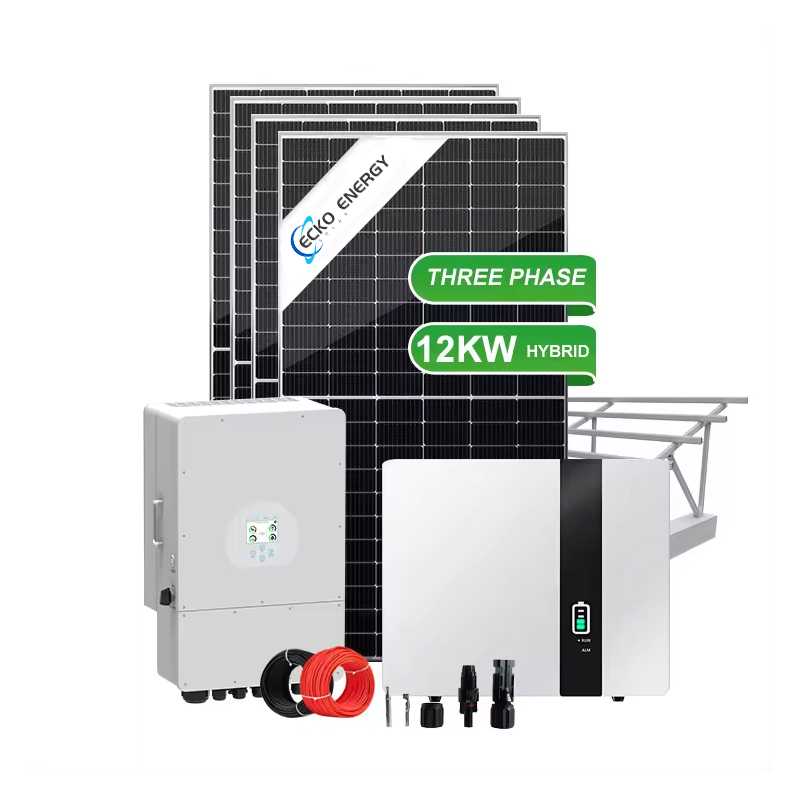
Continuous watts rarely trip an inverter. Combined motor starts do. The failure mode this step prevents is sizing surge as the largest single motor on the list, which passes every single-load check and still shuts the system down when two compressors or pumps start inside the same two-second window.
Walk the load list and find that window. A well pump and a fridge compressor restarting together after an outage is the common case; add a furnace blower or a sump pump and the window widens.
For each motor in the window, read the nameplate locked rotor amps (LRA) and multiply by the supply voltage to get startup watts. Where the nameplate omits LRA, a planning convention from generator-sizing practice puts LRA at roughly three to six times full-load amps (FLA), so use 6× as the conservative planning figure and flag it for confirmation. Then sum the startup watts of every load in the window. That total, not the largest single motor, is the surge number the inverter must ride through for the duration the spec sheet states.
Step 4: Calculate Usable kWh and Check Autonomy Hours Against the Stated Outage
Nameplate kilowatt-hours are not the number you divide by load. Derate first, then divide.
Derating line | Example: 10 kWh nameplate |
|---|---|
Depth of discharge (LiFePO4, 90%) | 9.0 kWh |
Round-trip efficiency (90%) | 8.1 kWh |
Cold-weather capacity reduction (85%) | 6.9 kWh |
Capacity fade at end of warranty (80%) | 5.5 kWh usable |
Lead-acid tops out near 50% depth of discharge; LiFePO4 is usually warranted to 80-95% (Solax). Treat those percentages as a vendor planning convention, not a universal standard, and use the warranty document for the unit you are quoting. Academic reviews treat derating as the standard way to extend lithium battery life (Imperial College London).
Divide usable kWh by the Step 2 continuous load to get battery autonomy hours. A 1.5 kW critical load on 5.5 usable kWh gives roughly 3.7 hours.
Against the outage figures above, one day of critical-load autonomy is the sensible default; two days is a deliberate upgrade, not a baseline.
Step 5: Run the Black-Start and Transfer Test Before Handover
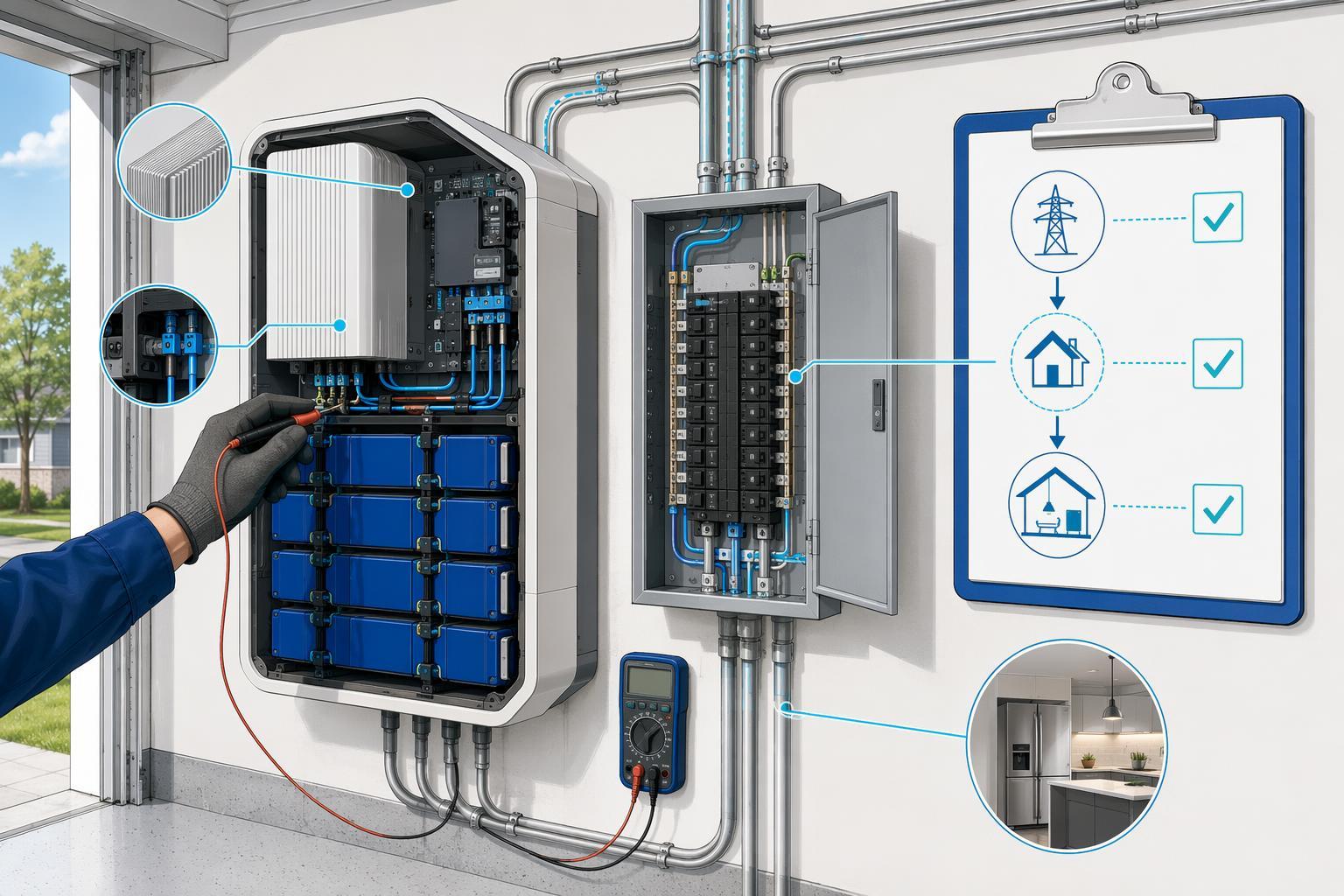
Black start means the battery can energize your home without the grid, not just during a grid outage, and EnergySage's explanation of black start notes that the capability is not automatic on newer systems. Treat it as a test you run, not a line you read off a spec sheet.
The sequence is short: kill the grid feed, confirm the inverter islands, watch the backed-up panel pick the load back up, then confirm the inverter restarts from a fully dark bus. The black-start test is the last two steps, and they are the ones that separate a grid-following inverter from a grid-forming one.
Three observable checks decide pass or fail:
The backed-up load stays up through the transfer. No flicker, no drop.
The microwave clock resets. If it does, that circuit is not actually backed up.
The inverter restarts with the grid still open. If it needs the grid to wake, it is not black-start capable.
Pre-handover checklist: grid feed opened, islanding confirmed, backed-up load held through transfer, microwave clock checked, inverter restarted from a dark bus, results recorded and signed by the installer.
We found no published millisecond transfer figure we could verify, so this procedure uses observable outcomes instead. Record what you saw, not what the datasheet promised.
Step 6: Plan Expandability Before the Order, Not After
The battery kWh is rarely what limits expansion. The inverter usually is. Energy Matters explains that inverters have fixed limits set at installation, and that added modules must share the communication system and stay inside those limits (Energy Matters). Treat that as architecture, not as code or voltage guidance: the question is not whether more cells exist, but whether the inverter and BMS will accept them.
A battery expandability plan is therefore four questions you put to every supplier before you sign, each answered by a named spec-sheet field.
Question to the supplier | Spec-sheet field that answers it |
|---|---|
How many modules can run in parallel? | Maximum parallel unit count |
How much inverter headroom remains after this build? | Rated continuous kW vs. installed load |
How many BMS addresses can the stack carry? | BMS address range and DIP/ID assignment |
Does CAN/RS485 and SOC reporting stay identical after adding a module? | Communication protocol and SOC reporting spec |
For reference, Ecko's stackable low-voltage platform covers 5 to 20 kWh, a manufacturer claim. No maximum module count, continuous kW, surge kW, DoD or warranty is published, so those four answers must come from the supplier directly.
Record the headroom figure in the final worksheet field: Expandability headroom: ___ kW / ___ modules.
Request the sizing worksheet to run the same four questions against a live configuration.
Common Mistakes That Break the Sizing Decision
The most expensive home battery backup sizing error is treating surge as the largest single motor instead of the combined start. A well pump at 2,200 W starting alone passes every single-load check, and so does the fridge compressor at 1,200 W. Start them within the same two-second window and the inverter sees the sum, trips, and the homeowner concludes the battery is undersized when the worksheet was. Add every motor that can start together, then size to that number.
Treating nameplate kWh as usable kWh. A 10 kWh module is not 10 kWh of backup. Depth of discharge and round-trip losses cut the deliverable figure, and the datasheet rarely states either. Ask for both before you divide.
Accepting cycle-life claims without a test method. Ecko Energy's own BESS page states a 6000+ cycle life and a lifespan of up to 15 years (Ecko Energy). That is a manufacturer claim, not third-party verified, and the page does not publish the test conditions behind it.
Skipping cold-weather derating. Capacity and available discharge current both fall as temperature drops. Size for the coldest expected operating condition, not the lab number.
Ordering a second module without checking headroom. Confirm inverter input limits and BMS addressing before the purchase order, not after the modules arrive.
Pro Tip: A claim without a documented test method should never be repeated to a homeowner as fact.
Frequently Asked Questions
How long will a 10 kWh battery actually run a critical-load panel?
Work from usable capacity, not the nameplate figure. At 90% depth of discharge a 10 kWh pack delivers about 9 kWh; at 80% it delivers 8 kWh. Divide by the continuous load from Step 1. A 500 W critical panel draws 0.5 kWh per hour, so 9 kWh usable covers roughly 18 hours; a 1,500 W panel covers about 6 hours. If the customer's stated outage runs longer, cut the load list or add capacity instead of assuming the battery will stretch.
Can a partial-backup panel be expanded to whole-home later?
Sometimes, and the answer is settled at order time. Expansion depends on whether the inverter accepts parallel or additional modules, whether the panel and transfer equipment can carry the larger load, and whether the supplier publishes a module or stack ceiling. Where no maximum module count or parallel-stack limit is published, treat the expansion envelope as unconfirmed and get it in writing before the customer plans around it.
What if the combined surge exceeds the inverter's surge rating?
Do not round the surge down to make it fit. Return to Step 3 and stagger the starts, sequencing the well pump and the compressor so their inrush windows do not overlap, using a soft starter or delayed-start relay on the largest motor. If the loads cannot be separated in time, the inverter is undersized for that panel and the customer needs a larger inverter or a load-management device that sheds the second motor during a start.
Does sizing change for a customer with medical equipment?
Yes, in two ways. Medical devices move to the top of the critical-load list and stay there, so they are never shed. The runtime requirement also changes: it is no longer the utility's average outage duration but the longest plausible outage for that customer, because running out is not an inconvenience. Size to that figure, document the assumption in the worksheet, and tell the customer plainly that a battery is not a substitute for the equipment's own backup or for medical advice.
Conclusion
The worksheet turns home battery backup sizing into four numbers you can defend: continuous watts, worst-case combined surge watts, usable kWh against the stated outage duration, and expandability headroom for the next load the customer adds. Those four figures answer a yes/no question about one specific battery against one specific load. They do not produce a general capacity recommendation, and no supplier should offer one without them.
Take the completed sheet to the next conversation rather than to a checkout page. Talk to an engineer about OEM specifications when you need the nameplate ratings, depth of discharge, transfer time and black-start behaviour that a spec sheet has to state before you repeat it to a customer.
Ecko Energy manufactures lithium batteries, solar inverters and integrated energy systems, with OEM/ODM and private-label programs for distributors, installers and EPCs.


