


Why Inverter Compatibility Makes or Breaks Your Home Energy Storage Battery
 Sep 30, 2026|
 View:314
Inverter compatibility is very important. It decides how your system performs, how safe it stays, and which features actually work. Treat it as a core specification, not a detail you check later.
A home energy storage battery can look strong on paper. It can still underperform or fail. Without clear communication and coordination with the inverter, the two parts cannot work as one system.
Your money and your safety depend on that relationship. A battery alone stores energy. The inverter decides how that energy flows, charges, and responds. When the pairing is wrong, you lose control of both.
Key Takeaways
Inverter compatibility decides how well your battery works and how safe it is.
A battery and inverter that don't match can lower efficiency by 20–40% and cause frequent shutdowns.
Communication protocols like CAN and Modbus must match for the system to work as one unit.
Mismatched parts can quietly turn off backup power and monitoring features.
Always check that the parts work together by testing and certification before you buy or install.
What Incompatibility Does to Your System
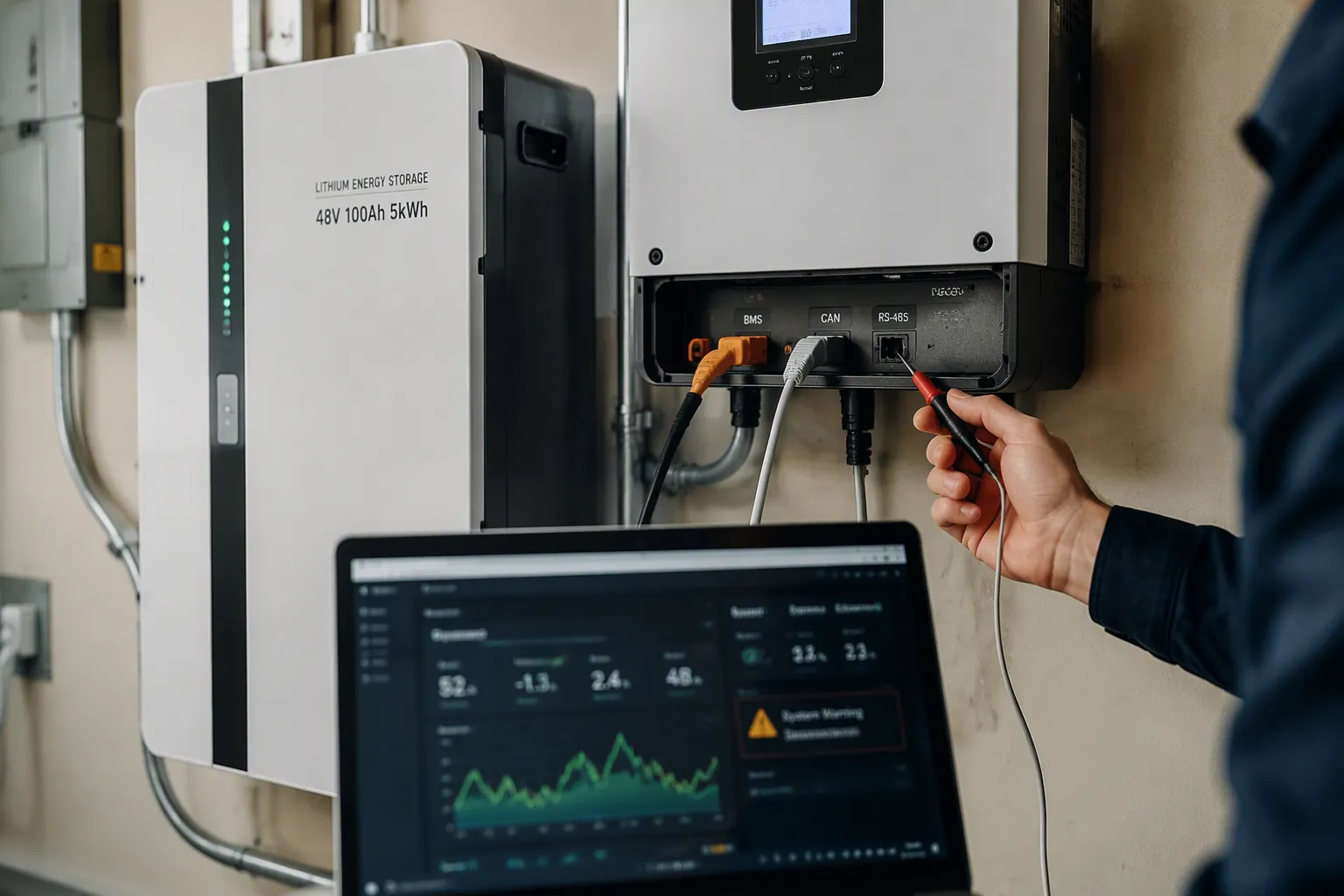
When the inverter does not support the right battery type, the system may charge the wrong way. It may lower usable capacity. It may also cause battery faults. These problems do not always show up on day one. They build up over weeks of use, and they often hide behind features that look fine on paper. The pairing decides whether the system acts as one unit or as two strangers.
Communication Errors and Lost Control
The battery and inverter must speak the same language. CAN and RS-485 are both used for BMS communication between lithium batteries and solar inverters. CAN is often chosen for closed-loop inverter communication. It is fast, strong, and made for many devices sharing a bus. RS-485 is widely used because it supports differential signaling, long cable runs, and Modbus-style protocols. Neither one is always better. The right choice is whatever both the battery BMS and inverter support, with matching protocol, cable, pinout, firmware, and configuration.
Attribute | Modbus | CAN Bus |
|---|---|---|
Architecture | Master-slave | Peer-to-peer (multi-master) |
Typical role in ESS | Inverter and meter monitoring | Battery Management System backbone |
Speed | Lower (up to ~115 kbps on serial) | Higher (up to ~1 Mbps) |
Error handling | Basic CRC/LRC checks | Advanced framing, arbitration, auto-retransmission |
Cabling | RS-485 or Ethernet | Twisted pair |
SunSpec is not a standalone protocol. It is a standardized data-model layer, most often carried over Modbus. It fixes where specific data points appear so equipment from different vendors can work together without custom integration code. When protocols do not match, you lose control. The monitoring platform may go offline. Data updates may arrive late. Operating information may go missing. The root cause usually lies in the communication path: unstable network connections, wrong settings, WiFi limits, or RS485 interface wiring. One mismatched pinout can silence the whole system.
Efficiency Loss and Instability
Mismatched battery and inverter parts can waste a large share of the energy you store, so it never reaches your loads. You pay to charge the battery. You pay again when the energy fails to come back out. The loss adds up every day. A system that cannot coordinate charge and discharge will waste capacity you already paid for.
Instability shows up in several ways:
Low-voltage errors are a common protection event, not necessarily inverter failure. They signal DC input voltage fell below the set threshold.
Inverters alarm or shut down when battery voltage drops to unsafe levels to prevent deep discharge, system instability, AC waveform distortion, and electrical damage.
If PV or utility charging is disabled or set up wrong, the battery may not recharge enough. The system then repeatedly enters low-voltage shutdown.
Misconfigured charging priority can trigger repeated switching events that look like low-voltage faults.
You may also see erratic charging, dropped communication, and reduced usable capacity. Unexpected shutdowns and repeated restart cycles can point to grid voltage fluctuation, overheating, low DC input, or abnormal settings. Reduced output power often traces to poor ventilation or overload. Abnormal output can come from uneven load distribution. Each symptom has a cause. Compatibility removes most of them before they start. You should treat every symptom as a clue, not a random fault.
Functional Gaps and Safety Risks
Features That Quietly Stop Working
Backup power, time-of-use shifting, and monitoring features can stop working without warning when protocols do not match. You may not see an alarm. The system may look normal while key functions quietly fail. The table below shows common failures and their symptoms.
Silently Failing Feature | Symptom / Consequence |
|---|---|
Power delivery control | Power delivery stops with no clear alarm |
Charging algorithm coordination | Battery life is harmed by wrong charging |
Operational cost management | Higher operating costs |
Data integrity (EMI/EMC) | Data gets corrupted from cross-talk in poorly designed systems |
Modbus addressing | System "goes haywire" from conflicting slave IDs |
Firmware compatibility | Batteries stop communicating after a firmware mismatch |
Signal termination | On-and-off Modbus errors from missing or wrong 120Ω termination resistors |
Real users report these problems. One installer described a setup with multiple inverters and several battery stacks. He forgot to change the Modbus slave ID on one battery controller. The whole system went haywire. He said it took forever to trace the problem among all the power cables. Another user upgraded his inverter firmware. His Pylontech batteries stopped talking. He downgraded the firmware and the system worked again. Support told him about a known incompatibility between the latest inverter firmware and older battery firmware.
Safety and Code Compliance
Using a PV inverter with a battery storage system without checking compatibility can break NEC 110.3(B). This rule requires equipment to be used per its listing. A Listed PV inverter paired with a lithium-ion battery bank in the field may create fire and electric shock hazards. The inverter must be Certified (Listed) for the specific input source and carry a proper input short-circuit current rating.
The hazard basis is serious. PV arrays are naturally current-limited. Their operating current is about 85% of short-circuit current. Lithium-ion batteries can produce fault currents up to about 50 times the battery bank's current rating. A PV-only Listed inverter on a battery source may fail catastrophically under battery short-circuit conditions. The compliant path is a complete Certified (Listed) ESS, such as a self-contained ESS Listed under FTBW per UL 9540. That listing checks component compatibility and the functional safety of protection systems.
Why Your Home Energy Storage Battery Depends on the Inverter
The Heart and the Brain
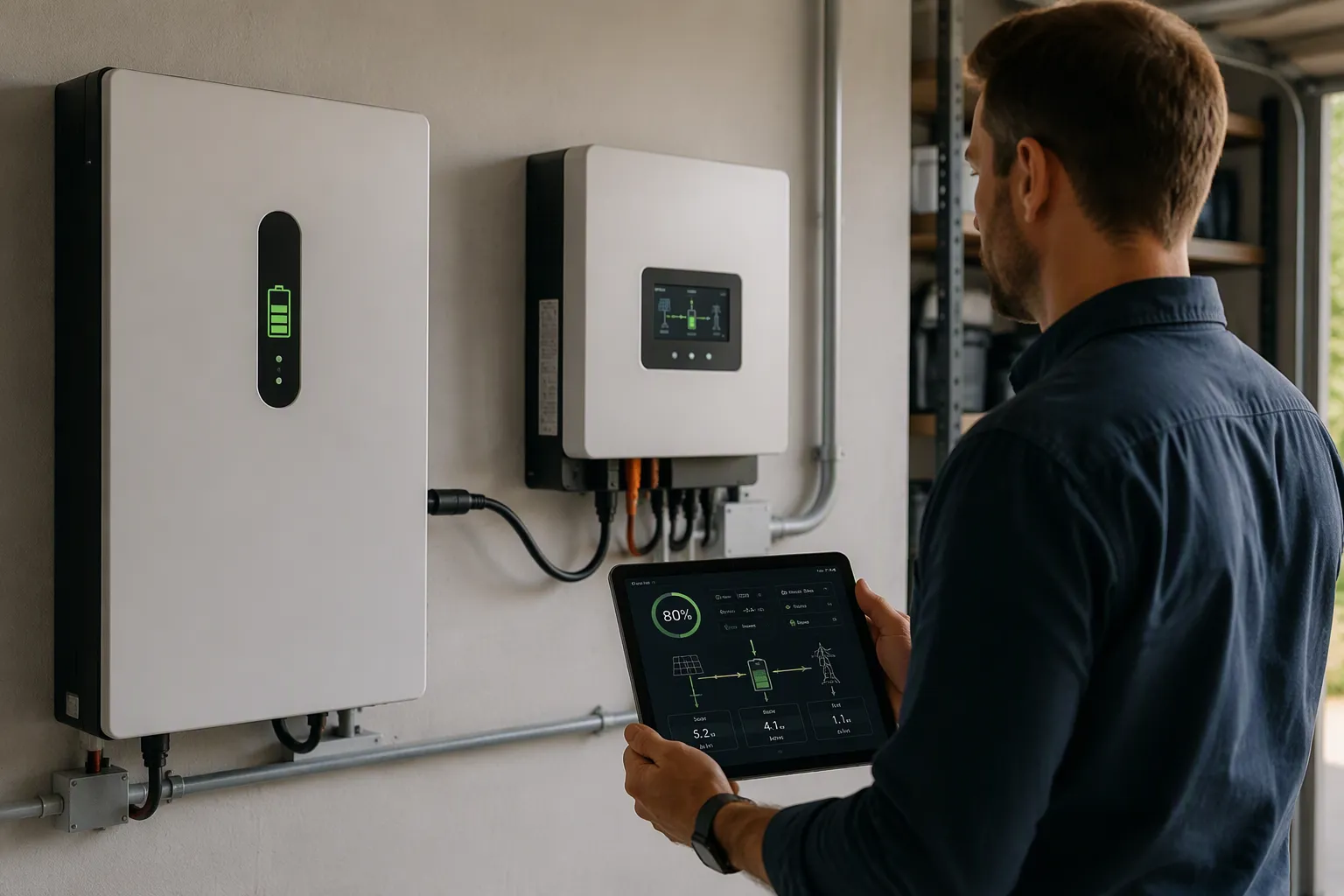
Think of the battery as the heart of your system. It stores energy and gives it back when your home needs power. Think of the inverter as the brain. It turns DC electricity from your panels and battery into usable AC electricity. It charges and discharges the battery based on how you use power and how much sun you get. It also decides whether energy comes from solar, battery, or grid, and where that energy should go.
In a battery energy storage system, the battery and inverter work as the 'heart' and 'brain' — they must 'speak the same language and have the same rhythm' to run at their best.
That rhythm depends on communication. Your battery's management system sends charge level, available power, voltage, and fault status to the inverter in real time. The inverter uses this data to manage charge and discharge rates, respect charge limits, and trigger a soft shutdown when the battery gets close to empty. Without reliable communication, the inverter runs blind. Overcharge or deep discharge becomes possible. Your home energy storage battery then runs on guesswork instead of control.
Performance, Longevity, and Cost
Compatibility reaches far beyond whether the system turns on. It shapes how long your battery lasts and whether your warranty stays valid. A correct pairing extends battery life, cuts maintenance needs, and keeps warranty coverage. An incorrect charging profile does the opposite. The battery overheats during charging, cycle life drops, capacity fades quickly, and the battery may never fully charge. That damage can put your warranty at risk. The fix is practical: pick the correct battery chemistry profile in the inverter settings. If that profile is not there, set charge voltage, current limits, and termination parameters by hand per the manufacturer's specs, then check with several charge-discharge cycles.
Compatibility Aspect | Effect on Cycle Life and Warranty | Recommended Action |
|---|---|---|
Proper compatibility verification | Extends battery life, reduces maintenance, preserves warranty coverage | Follow a step-by-step compatibility check before installation |
Incorrect charging profile | Overheating, reduced cycle life, rapid capacity fade, possible warranty loss | Set the correct chemistry profile or configure parameters manually, then test |
Total cost of ownership follows the same logic. The choice between AC-coupled and DC-coupled storage ties directly to your inverter's design. AC-coupled systems need a separate inverter to charge the batteries, which adds equipment cost. DC-coupled systems need a switching system to break panel strings into groups, which adds design complexity. How ready your existing inverter is for storage decides whether you add storage simply or buy extra hardware. Inverter age and remaining warranty may force a replacement before storage goes in. A standard grid-tied inverter also shuts down during outages, so backup power requires more inverter investment. Each of these factors adds cost. A verified pairing removes most of them upfront.
How Ecko Energy Ensures Compatibility
Battery Energy Storage Systems Built for Compatibility
Ecko Energy designs its Battery Energy Storage Systems with one goal in mind: your battery and inverter must work as one unit. The company's own Smart BMS checks voltage, current, and temperature in real time. It keeps the cells balanced at all times and sends status to the inverter right away. This setup works with more than 20 hybrid inverter brands, such as Victron, Deye, and Growatt. You get a home energy storage battery that speaks the inverter's language from the first time you turn it on.
The cells are just as important. Ecko Energy uses Grade A CATL/EVE LiFePO4 cells. These cells last more than 6,000 cycles and have a 10+ year lifespan. The modular design runs from 5.12kWh to 187kWh, so you can size a system for an apartment, a villa, or a small commercial site. You can add capacity without changing the inverter pairing.
Testing, Certification, and Support
Every unit goes through a 100% aging test before it ships. Ecko Energy also holds CE, UN38.3, and MSDS certification, and it pre-tests systems for IEC62619 and UL readiness. These steps confirm the battery meets recognized safety and performance benchmarks before it reaches your site.
Certification / Standard | Purpose |
|---|---|
UL 9540 | Safety standard for energy storage systems, covering fire safety and operation |
UL 9540A | Fire spread and thermal runaway testing |
UL 1973 | Battery safety standard |
UL 1741 | Inverter and grid connection standard |
IEEE 1547 | Distributed resource interoperability |
CE Marking | Health, safety, and environmental compliance for the European market |
ISO 9001 | Quality management system requirements |
IEC 61508 | Functional safety for electronic systems |
Ecko Energy also offers OEM/ODM services. You can customize enclosures, branding, and firmware. The team tunes communication protocols for the inverter you choose and gives technical support before and after the sale. That support turns a spec sheet into a working, verified pairing.
Inverter compatibility decides if your home energy storage battery gives you real performance, safety, and every feature you paid for. Treat it as a core sourcing step, not something you think about later. Confirm the pairing through testing, protocol alignment, and clear supplier support before you commit.
Homeowners should ask for proof that the pairing was tested. Installers should check firmware versions and communication settings at setup. A few minutes of checking now protects your investment for years.
FAQ
How do I check inverter compatibility before I buy a battery?
Start with the list of inverters the battery is approved to work with. Make sure both sides use the same protocol, like CAN or Modbus with SunSpec. Match the cable pinout and firmware version. Ask the supplier for a record showing the pairing was tested. Ecko Energy works with more than 20 hybrid inverter brands, including Victron, Deye, and Growatt.
What happens if my inverter firmware updates later?
A firmware update can break a link that already works. One user's batteries stopped communicating after an inverter upgrade. The fix was to roll the firmware back. Check the release notes before you update. Make sure the battery maker has tested the new version. Keep a record of the firmware pair that works.
Can I pair a battery with a PV-only inverter?
No. A PV-only Listed inverter may not have the right input rating for a battery source. That pairing can break NEC 110.3(B) and create fire and shock hazards. Choose a complete system Listed to UL 9540 instead. That listing confirms the parts work together safely.
Can I add battery capacity later without changing my inverter?
Yes, if you plan for it. Ecko Energy's modular design scales from 5.12kWh to 187kWh. First confirm the inverter's supported voltage window and maximum charge current. Then add modules within those limits. The original pairing stays valid.
What proof of compatibility should I request from a supplier?
Ask for three things: the tested inverter list, the certification documents, and protocol settings for your model. Look for CE, UN38.3, and MSDS papers, plus IEC62619 and UL readiness. A supplier who ran 100% aging tests can share those results too.


